


by Louw Lemmer · August 3, 2026
The hidden city beneath the bush, and the life it shapes above ground.
Your safari guide knows this stretch of bush the way you know your own street. Over a single morning drive he will hand you a hundred small facts, and somewhere between fresh leopard tracks and the next big sighting, a few of them slip past you. Then you pass a low mound of hard earth, easy to ignore, and Colbert says, almost in passing, that it is older than you are. And then he tells you its story.

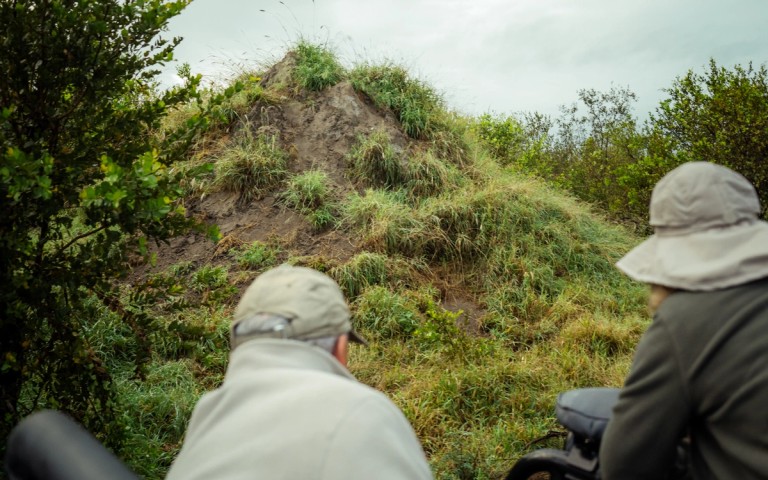
A 60- to 70-year-old termite mound in the Sabi Sand during a morning game drive.
The city under the mound
What looks like a heap of dirt is the roof of a city. Beneath and inside it live millions of termites, ruled by a single queen who does one job, laying eggs, and does it for around twenty years, which makes her one of the longest-lived insects on earth. The mound above ground is the smaller part of the structure. Most of the colony runs deep below it, through chambers the termites build and tend in the dark, carrying up every grain of soil bound with saliva and patching the walls after each rain. After a wet season like the last one, that is a great deal of patching.
They are also farmers. These termites cannot digest the dead grass and wood they gather, so they grow a fungus that can, tending it in gardens deep inside the mound. That fungus has to sit at around thirty degrees no matter what the heat is doing outside, so the mound is built as a climate-control system. Chimneys and air ducts push warm, stale air out and draw cool air in, and the workers open and close tunnels through the day to hold it steady. It is not so different from your suite at the lodge: large, comfortable, and kept exactly right regardless of what the bush is doing beyond the glass. The difference is that the termites have been managing it, without a thermostat, for decades.
Silvan guide Colbert explains the intricate details of a termite mound.
The engineers of everything above them
The colony does not keep the benefit to itself. In feeding the mound, termites pull dead plant matter down into the ground and break it open, and over the years the soil around a mound becomes some of the richest in the reserve. Grass grows greener and thicker there, in a ring you can pick out from the vehicle once you know to look for it. The grazers know it too. Impala and wildebeest crop these patches first, which means the predators that follow them are rarely far away.
Birds add another layer. They perch on the high point of a mound to watch for food, and the seeds that pass through them fall into that fertile soil and take root, so that in time an old mound can carry its own small stand of trees, a patch of shade standing alone in open ground. One mound, without meaning to, shapes the grazing, the hunting and the growing around it. Some of the largest patterns in the bush are set by its smallest architects.
The grass around a termite mound is typically greener and lusher.
What happens when the colony dies
Every colony eventually dies. A queen lives around twenty years, and when she goes the colony usually goes with her. The mound, though, often outlives her. A new colony will move into the old structure rather than start from nothing, inheriting the walls and the chimneys, which is how a mound in the Sabi Sand can reach the sixty or seventy years the guides will tell you it has stood. Some mounds elsewhere in Africa, carefully dated by scientists, have turned out to be thousands of years old. The one beside the road may well have outlived every leopard that ever climbed it.
When a mound is finally left empty for good, you might take that for the end of the story. It is closer to the beginning. An abandoned mound is prime real estate, and the queue for it is long. An aardvark usually breaks in first, digging for a last meal and leaving holes wide enough to set the next wave of tenants in motion. Warthogs enlarge them into dens and reverse inside at night, tusks to the entrance. Wild dogs and spotted hyenas raise pups in the bigger cavities. Dwarf mongooses take the smaller ones and post a sentinel, a lookout who stands upright on the summit and watches for danger while the rest forage below, often with a hornbill perched nearby doing the same job in return for the insects the mongooses flush out. Monitor lizards lay their eggs in the warm walls. Snakes move in behind the mongooses, following an easy meal. And on the very top, where the view is longest, a leopard or a cheetah will climb up to scan the ground for prey, using the old tower exactly as its builders never intended.
A termite mound is never as still as it looks. First it hides a city of millions. Then, when they are gone, it fills right back up.
Even the smallest residents of the Sabi Sand reward a closer look.
Why we stop
You come to the Sabi Sand for the big things: the Big Five, the wild dogs, the pull of the bush itself. And you should. But a safari has more depth than its headline animals, and the longer you are out here, the more of it you notice.
Almost nothing in the bush is guaranteed. The Big Five is not a promise. Even an elephant, as likely as one is, can stay out of sight all morning. What you can count on is smaller and more certain: you will pass a termite mound or two on every drive, and the guide will have a story about it. Learn to read the mound and you start to see the whole ladder it belongs to, the soil, the grass, the grazers, the hunters, each rung resting on the one below. The big animals sit at the top of that ladder. The mound helps hold it up.
One of the leopards guests hope to see on this traverse is called Xidulu, and her name, in Shangaan, means termite mound. It is a fitting borrow. Both are easy to overlook, and far more central to the life of the bush than they first appear. Spend a morning learning to read the one, and you tend to leave Silvan noticing the other everywhere.
Xidulu, the leopard whose name means termite mound.
Enquire about your stay at Silvan.
Silvan Safari is located in the Sabi Sand Private Game Reserve, Greater Kruger, South Africa.