


by Louw Lemmer · September 21, 2026
What the animals’ alarm calls reveal, and what a leopard may do with the warning.
On a recent drive in the northern Sabi Sand, Silvan guide Clayton Herb heard impala alarm calling and went to investigate. The impala fell silent. Clayton waited. Then the helmeted guineafowl began calling deeper in the bush. The impala’s silence had not settled what was there.

Ask your guide to point out the* snort of an impala. It’s quite recognizable.
What the animals have seen
Clayton does not hear every alarm in the same way. Impala bunched together, snorting and staring at one spot, generally point him towards leopard or lion. Monkeys calling high in the canopy generally suggest leopard. Baboons alarming and moving frantically from the ground into trees generally suggest lions. These are local patterns he trusts, rather than a way to identify a predator from sound alone.
Asked which caller he trusts most, Clayton names kudu or monkey. In his experience, they rarely alarm without something there. He watches where the caller is looking and what it does next. The impala on that recent drive gave him a direction he kept in mind after the sound stopped.
A kudu’s alarm is among the more trustworthy in the bushveld.
How a call becomes a search
When an alarm call reaches the vehicle, the guide and tracker first try to place it. They listen for its direction, watch where the caller is looking and wait to hear whether another animal joins in. Then they compare the sound with the other evidence around them: fresh spoor (animal tracks) on the road, the ground ahead and where lions or leopards were last seen. One call gives them a possibility. Several clues pointing towards the same patch of bush give them a route.
Much of the communication between guide and tracker is easy to miss. A lifted hand, a glance or a few words can be enough to slow the vehicle or change direction. A short radio call may tell them what another team has seen and where, but it does not complete the search. Once they reach the area, the engine goes off and the guiding team listens for what happens next.
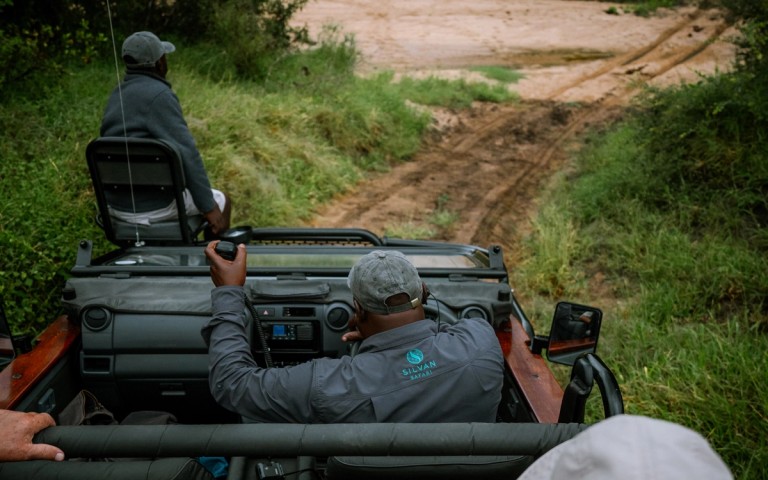
From the tracker’s seat up front to the guide on the radio, each clue is shared as the search takes shape.
The call that followed the silence
The drive began near a quarry. The impala alarmed; Clayton turned towards them. Then they stopped calling. He says sudden silence generally means the predator has moved off. On this occasion, he stayed a while rather than treating that usual reading as the end of the search.
Deep in the bush, a helmeted guineafowl began alarm calling. Clayton drove towards the sound. The birds suddenly flew up, and a minute or two later he spotted a female leopard walking through the thicket, marking territory. The impala had gone quiet while she was still nearby. What changed from the impala’s point of view remains uncertain, but the guineafowl gave the team another clue to follow.
Alarm calling guineafowl gave Clayton a second direction after the impala fell silent.
The leopard waiting beyond the lions
Most times, Clayton says, impala spot a leopard and the leopard moves off once it has been seen. An alarm can help a guide locate the cat while the cat loses the cover it needed to approach unseen. There is another possibility, though, when more than one predator is involved.
A couple of years ago, Clayton watched a very different encounter. Lions were spotted. A leopard arrived, hid and waited for the impala to move towards her. Their response to one predator gave another a possible opening. The calls may have drawn her in, or the moving impala may have done it. Either way, Clayton and a group of very excited guests watched the leopard wait while the herd of impalas focused on the lions.
A leopard may benefit from the disturbance created by nearby lions.
Why fewer vehicles matter
Exclusivity in the Sabi Sand is partly a matter of numbers. Silvan has six suites and only two Land Rovers in the field during game drives. At a sighting, no more than three reserve vehicles are generally allowed at once. Around young or sensitive animals, that limit can fall to two or even one. Other vehicles respectfully wait their turn.
For Silvan Safari guides and guests, those limits protect more than the view. They also protect the conditions in which a guide and tracker can work. When the guide cuts the engine, an impala’s snort carries. Guineafowl calling from inside a thicket can be placed. When the calls stop, the change is clear. The privacy of a Sabi Sand drive is felt in those minutes before a sighting, when there is little human noise between the guiding team and the next clue.
Guests may remember the leopard stepping from cover. The guiding team will also remember the sequence that led there: the impala, the silence, the guineafowl and the decision to wait.